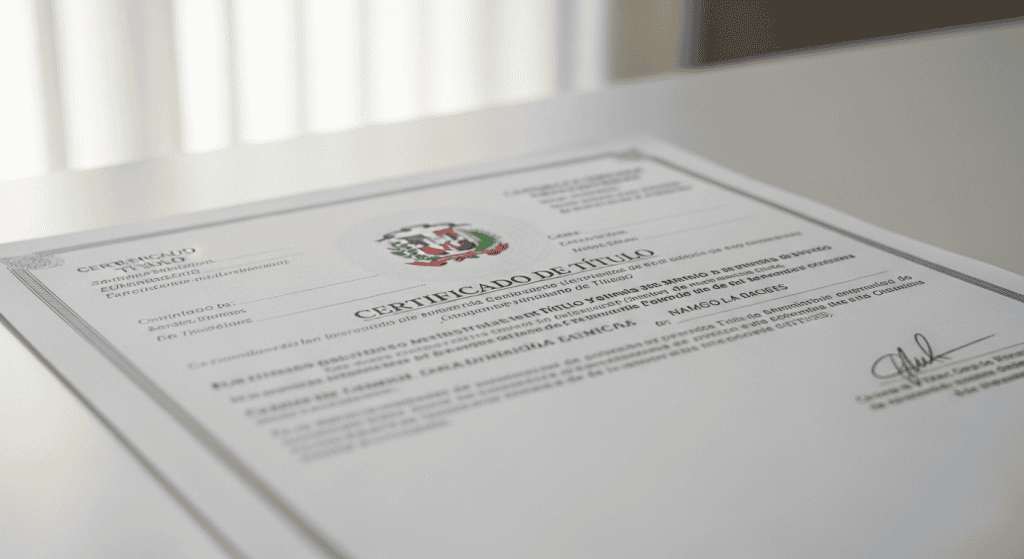
You’ve been handed a document. The developer calls it the title. It looks official. Embossed seal, registry numbers, government letterhead. The seller assures you it’s clean.
But what does it actually say? And more importantly, what doesn’t it say?
Most foreign buyers in the Dominican Republic make one of two mistakes: they either skip reviewing the title entirely, or they look at it, see that it exists, and conclude that everything is fine. Neither approach protects them.
A Dominican Republic title certificate, the Certificado de Título, tells you one thing: that a property right is registered. Understanding a title certificate is foundational to identifying the title-related risks that affect foreign buyers in Dominican Republic real estate. What it does not tell you is whether that right is clean, encumbered, disputed, or worth the paper it is printed on.
This guide walks through what every field in the certificate means, what the certificate cannot show you, and what an independent attorney verifies that you cannot see on your own.
In This Article
- The First Thing to Check: Blue or Pink?
- What Is a Dominican Republic Title Certificate?
- The Six Fields Every Certificate Contains
- What the Certificate Tells You (and What It Does Not)
- Three Things Not on the Certificate That Affect Your Purchase
- How an Attorney Verifies the Full Title Chain
- Red Flags in a Title Certificate
- Frequently Asked Questions
- A blue certificate (Certificado de Título) means individual ownership of a defined parcel. A pink certificate (Constancia Anotada) means you own square meters within an undivided parcel , a fundamentally different right.
- The certificate confirms a right was registered. It does not show current liens, encumbrances, litigation holds, or boundary disputes. You need the Certificación de Estado Jurídico for that.
- Four fields require active verification: the matrícula must match all documents, the registered owner must have actual authority to sell, the area must match the contract, and the boundary description must be specific.
- Falsified title certificates exist. The only reliable verification is a direct query to the Registro de Títulos ; the copy provided by the seller or developer is not sufficient.
The First Thing to Check: Blue or Pink?
Before you read a single field, look at the color.
A standard Dominican Republic title certificate is blue. This is the Certificado de Título: full, individual ownership of a delimited property with defined boundaries and a specific location.
A pink certificate is something different. It is called a Constancia Anotada.
With a Constancia Anotada, you own a quantity of square meters within a larger parcel, but the exact location of those meters within that parcel has not been determined. You own a share of something. You do not own a specific, bounded piece of land.
This distinction matters enormously. Most foreign buyers presented with a pink certificate do not understand what they are looking at. The developer calls it a title. The agent calls it a title. Technically, it is a registered property right. But what it represents is fundamentally different from what most buyers expect.
Before doing anything else with a property document, confirm the color. If it is pink, you need to understand what that means for your specific transaction before proceeding.
What Is a Dominican Republic Title Certificate?
The Certificado de Título is issued by the Jurisdicción Inmobiliaria (the Dominican Republic’s real estate registry system), recorded by the Registro de Títulos, one of several regional registries that operate under the Jurisdicción Inmobiliaria.
It establishes that a property right has been registered in the name of a specific person or entity. That registration creates a legal presumption of ownership.
The Dominican real estate registry system was reformed significantly by Law 108-05 (the Real Estate Jurisdiction Law), which established the current framework for title registration, mensura (survey), and dispute resolution. Properties registered under this system carry stronger legal protections than those that were registered under older frameworks.
Understanding which legal framework governs a specific title is part of what makes independent review essential.
The Six Fields Every Certificate Contains
1. Matrícula (Registration Number)
This is the unique identification number for the property in the registry system. There is no standard format. It is a number assigned at registration. This number ties the certificate to the actual registry record for that specific property.
What to check: The matrícula must match across all documents you have been provided. If the matrícula on the contract differs from the matrícula on the certificate, that is a problem that requires immediate clarification.
2. Propietario (Owner of Record)
The name or legal entity registered as the owner. This field tells you who legally owns the property at the time the certificate was issued.
What to check: The owner must be who you expect it to be. In many pre-construction situations, the certificate is not in the developer’s name. It is in the name of the original land owner, or the name of a company that holds the land. This is not automatically a problem, but it requires explanation.
A developer who is only a contractual owner of the land, meaning they have a purchase agreement with the original owner but do not yet hold title, cannot transfer clear title to you. If the project becomes unviable for any reason, you have no registered claim against anyone with assets. The certificate tells you exactly who owns the land. Read this field with care.
Practical note: If the owner of record on the certificate is not the developer’s name or company, ask for a written legal explanation before proceeding. This situation is common and sometimes legitimate, but it requires a specific verification of the developer’s authority to sell.
3. Designación Catastral (Cadastral Reference)
Every title in the Dominican Republic has a cadastral designation: a reference number that links the registry record to the physical location of the surveyed parcel. This is one of the two identifying elements you will find on any modern title, along with the matrícula.
4. Superficie (Area)
The registered size of the property in square meters. This is the legally recognized area.
What to check: The area on the certificate must match the area in the purchase contract. Developers sometimes market square footage that does not match the registered area. The legal area is what you are buying.
5. Ubicación (Location)
The physical address and municipal location of the property. Described in terms of the section, municipality, and province.
What to check: Verify that the location described matches where you believe the property is. In rapidly developing areas, parcel boundaries shift and addresses change. Confirm the physical location corresponds to the registered location.
6. Descripción de Linderos (Boundary Description)
The boundaries of the property, who or what borders it on each side. Written in legal format: Norte, Sur, Este, Oeste (North, South, East, West), with neighboring parcels or natural features identified.
What to check: Boundary disputes are among the most common property conflicts in the Dominican Republic. For residential lots, houses, and land parcels, overlapping boundaries (where two registered properties claim the same physical ground) are a known issue in certain areas. If the boundary description is vague, references an entity that no longer exists, or conflicts with what you have been shown on a site plan, investigate before proceeding.
What the Certificate Tells You, and What It Does Not
The certificate tells you that, at some point in the past, a specific property right was registered in a specific name.
It does not tell you:
- Whether that registration is still current (it may have been transferred since)
- Whether there are liens or encumbrances recorded against it
- Whether there is active litigation affecting the property
- Whether a third party is claiming ownership
- Whether the property has a servidumbre (easement) that limits your use of it
- Whether the boundaries are disputed
- Whether the property is subject to an inheritance claim
None of these things appear on the face of the certificate. All of them can make a clean-looking title deeply problematic.
Critical: A title certificate is a snapshot from the past. It does not reflect current liens, judicial annotations, or encumbrances recorded after it was issued. The Certificación de Estado Jurídico, obtained directly from the Registro de Títulos at the time of your due diligence. That document is what shows the actual current legal status.
One more thing: falsified title certificates, while not common, do exist. A certificate on its own is not sufficient proof that the underlying registration is legitimate. The document that actually reflects the current legal status of a property is the Certificación de Estado Jurídico, obtained directly from the Registro de Títulos. That is what an independent attorney requests, and that is what reveals what the certificate alone cannot show.
The Three Things Not on the Certificate That Still Affect Your Purchase
1. The Certificación de Estado Jurídico
This is the document that matters most, and most buyers never ask for it.
The Certificación de Estado Jurídico is issued by the Registro de Títulos and reflects the current legal status of the property: every annotation, lien, encumbrance, litigation hold, and restriction recorded against it. A property can have a clean, properly issued title certificate and simultaneously have a judicial annotation recorded against it that makes it legally untransferable.
The title certificate is a snapshot from the past. The Certificación de Estado Jurídico is what is true now. You cannot see one from the other. It must be obtained directly from the registry at the time of your due diligence, not months before.
2. Inheritance Disputes and Pending Litigation
Inheritance disputes in the Dominican Republic are common, and they can persist for a long time. In some cases, more than seven years. A property can be tied up in an inheritance proceeding that does not appear on the certificate itself but that creates a legal cloud on the title.
Foreign buyers operate with an assumption they should not make: that the Dominican Republic’s legal system is similar to theirs. It is not. A dispute that would be resolved in months in the United States or Canada can be unresolved for years here. Before purchasing, an attorney verifies the litigation status of the property through the Jurisdicción Inmobiliaria and the relevant civil courts.
3. Unregistered Easements and Use Restrictions
A servidumbre (an easement that gives a third party a right to use part of your property, or that restricts what you can build) may exist without appearing prominently on the certificate. Utility easements, access easements for neighboring properties, and government reservations along coastal or riverfront properties are among the most common.
In one type of case that appears regularly in practice: a buyer purchases a beachfront property, builds a fence to the water, and is later told by the government that a portion of the property falls within a maritime-terrestrial zone where private construction is restricted. The title was clean. The restriction was not on the certificate. It was in the land-use records that were never checked.
Don’t Read the Title Alone
A Pre-Purchase Property Check includes a full title chain review: Certificación de Estado Jurídico, litigation search, boundary verification, and developer ownership confirmation. Everything the certificate doesn’t tell you.
Learn About the Property Check™
Or schedule a free consultation to discuss your specific situation.
How an Attorney Verifies the Full Title Chain
An independent title review goes well beyond reading the certificate. It includes:
Registry verification: The attorney queries the Registro de Títulos directly to confirm the certificate is legitimate and that there are no annotations that do not appear on the document you have been given.
Certificación de Estado Jurídico: Obtained at the time of due diligence, not borrowed from the seller. A recent certification shows the current encumbrance status.
Boundary verification: Confirms that the registered boundaries match reality, including checking for overlapping boundary claims, a known issue in certain areas of the country.
Jurisdicción Inmobiliaria litigation search: Checks for pending cases before the Tribunal de Tierras (the specialized land court) that could affect the property.
Ownership chain verification: Traces the transfer history to identify whether there are legitimate questions about any previous transfer in the chain.
Developer ownership status: Confirms whether the developer actually holds title or is operating under a contractual arrangement with the original landowner.
This last point is where many transactions fail. A developer can market a project, accept deposits, and build for years without ever holding title to the land. The original landowner holds the title throughout. The developer holds a purchase option or a long-term lease. If the project collapses for any reason (financing, construction delays, regulatory issues), the investor has a claim against an entity that may have no assets to satisfy it. The title was clean. The developer just never owned what they were selling.
Red Flags in a Title Certificate
These are the situations that warrant immediate independent review before proceeding:
The certificate is pink (Constancia Anotada). You own meters within an undivided parcel. Understand exactly what that means before signing.
The owner of record is not the developer. Ask why. Get a clear legal explanation of the chain between the registered owner and the developer.
You have not seen a Certificación de Estado Jurídico. The certificate alone tells you nothing about the current legal status. A current certification from the Registro de Títulos is non-negotiable.
The area on the certificate does not match the contract. Do not proceed until this discrepancy is resolved in writing.
The developer cannot produce the certificate. A developer who cannot show you the title for the land on which they are building is a developer whose project requires careful scrutiny.
The boundary description is vague or references entities that no longer exist. In certain areas of the country, overlapping boundary claims are a known problem. Vague boundaries are a reason for deeper review, not a reason to proceed.
The Certificate Is the Starting Point, Not the Answer
A Dominican Republic Certificado de Título is a document that confirms a registered property right exists. It is not a guarantee that the property is clean, clear, and safe to purchase.
An experienced independent attorney can tell you within 30 seconds of looking at a certificate whether it warrants deeper investigation. The color. The owner’s name. The matrícula. These are the first data points. The real work: the Certificación de Estado Jurídico, the litigation search, the boundary verification, the developer ownership confirmation. All of that happens after.
If you are purchasing property in the Dominican Republic, the certificate is the beginning of your due diligence. It is not the end.
A Pre-Purchase Property Check examines all of this before you sign. It costs a fraction of what a title problem costs to resolve after the fact, if it can be resolved at all.
If you have questions about a specific title or property situation, a free consultation call is the place to start.
Once you know how to read the certificate, you’ll be better equipped to spot property title problems in the Dominican Republic that could affect your transaction.
One of the most alarming things you can find is that the title isn’t in the developer’s name — here’s what that means for your purchase.
Frequently Asked Questions
What is a Dominican Republic Certificado de Título?
A Certificado de Título is a document issued by the Registro de Títulos confirming that a specific property right is registered in a specific name. It is the primary evidence of ownership in the Dominican Republic’s real estate system but requires additional registry verification to confirm the property’s current legal status.
What is a Constancia Anotada and why does it matter?
A Constancia Anotada (pink certificate) is a registered right to a quantity of square meters within a larger, undivided parcel. Unlike a full title (blue certificate), it does not represent ownership of a specific, bounded piece of land. This creates significant risk for buyers who do not understand the distinction, particularly in condominium and development projects where individual units have not yet been formally separated from the parent parcel.
Can a property have a clean title and still have legal problems?
Yes. The Certificado de Título is a snapshot of registered ownership at a point in time. It does not show liens, litigation holds, inheritance disputes, or encumbrances recorded afterward. A Certificación de Estado Jurídico from the Registro de Títulos, obtained at the time of purchase, is the only way to see the current legal status of the property.
How do I verify a Dominican Republic property title?
Verification requires: (1) confirming the certificate is legitimate against the registry record, (2) obtaining a current Certificación de Estado Jurídico directly from the Registro de Títulos, (3) verifying boundaries and checking for overlapping claims, and (4) checking for pending litigation before the Tribunal de Tierras. This process requires access to Dominican registry offices and knowledge of the Jurisdicción Inmobiliaria system. Independent legal review before purchase is how this is done.
What does it mean if the title is not in the developer’s name?
It means the developer does not hold registered ownership of the land they are selling. They may hold a purchase option, a long-term lease, or a contractual arrangement with the registered owner. This is not automatically disqualifying, but it requires careful legal review. If the project fails, a buyer’s ability to recover their investment depends on the financial position of an entity that does not appear on any title.